
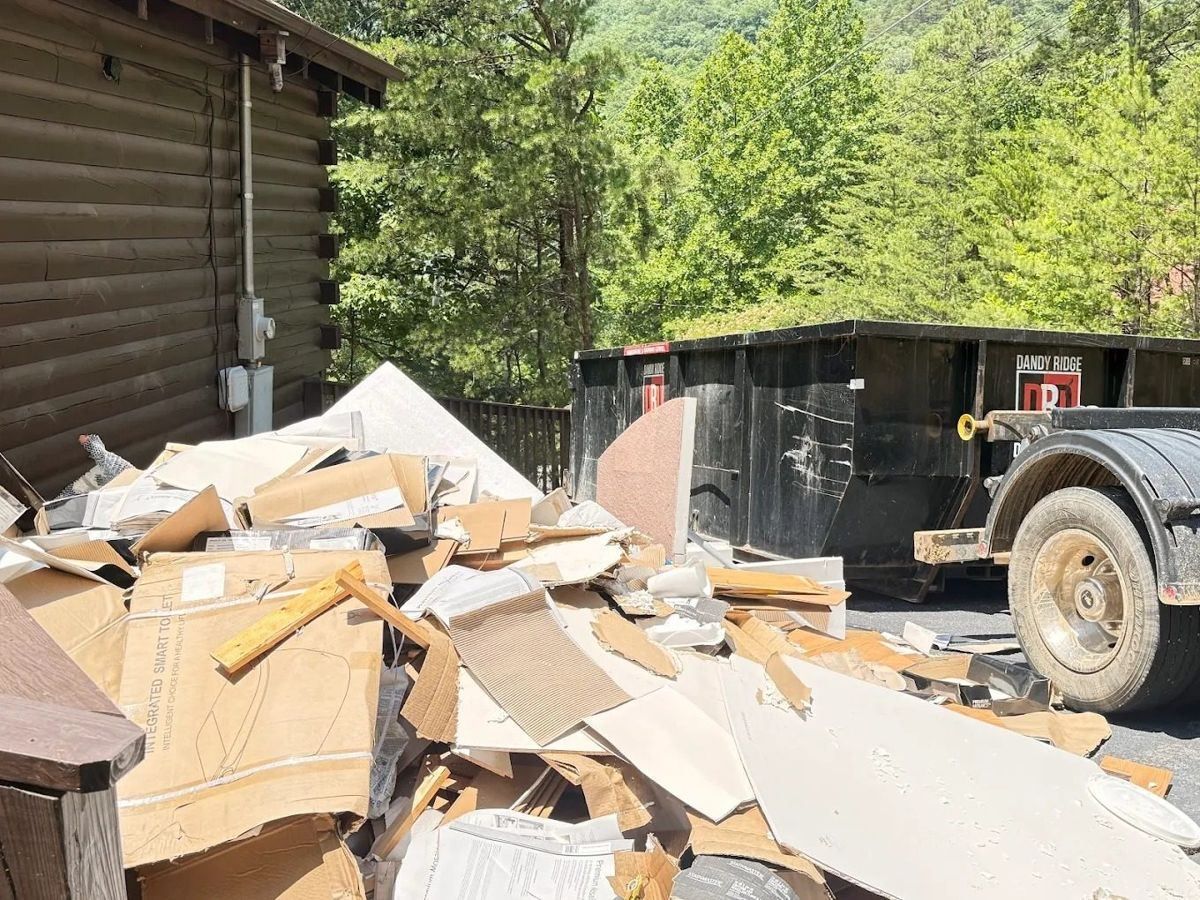
Every roll-off rental from Dandy Ridge Dumpsters includes up to 1 ton of weight, which is 2,000 pounds. Whether your load comes in under that number is the single biggest factor in what you end up paying, so it's worth thinking about before the dumpster lands in your driveway. Jason Martin runs Dandy Ridge out of Dandridge, and we haul for folks all over Jefferson County and the towns around Douglas Lake. That runs from Jefferson City and Morristown to White Pine, New Market, and out toward Knoxville. Here's how to get a feel for what your debris weighs before you book.
What does going over a ton cost?
Extra weight runs $85 per ton in Jefferson, Hamblen, and Cocke County, and $125 per ton farther out in places like Sevierville, Knoxville, Kodak, and Seymour. We charge from the exact scale weight at the landfill, never rounded up, so half a ton over costs you half the rate. The base rentals are on our pricing page: the 20-yard is $375 for 3 days or $475 for 7, and the 15-yard is $450 for 7 days when it's available. Every one of those includes the first ton.
Which loads usually stay under a ton?
Household cleanouts almost always do. Furniture, boxes, clothes, old toys, that exercise bike, the stuff that comes out of a garage or an attic is bulky but light for its size. On a cleanout, you'll run out of room in the dumpster long before you run out of weight. That's most of the jobs we do, and it's why the included ton covers the large majority of our customers without any extra charge.
What kinds of debris are heavy?
Roofing shingles are the big one. A single layer of asphalt shingles weighs roughly 250 pounds per square, which is 100 square feet of roof, so about 8 squares gets you to a ton. Before a tear-off, run your roof through our shingle weight calculator and you'll know your number before you book. The other loads that sneak up on people: old tile, plaster from a wall teardown, and anything wet. Water-damaged carpet or soggy cardboard out of a basement weighs a whole lot more than the dry version.
Why don't we take concrete or dirt at all?
Because even a partial load of it hits the truck's legal weight limit. Concrete, dirt, rock, and fill material can't go in our dumpsters, period. It isn't hazardous, it's just too heavy to haul safely in a roll-off. The full rundown of what goes in and what stays out is on our acceptable items page. Got a pile of concrete you need gone? Call us anyway and we'll point you the right way.
How do you find out what your load actually weighed?
You see the same number we do. When we dump your load, the landfill weighs it, and that scale ticket goes out with your invoice along with photos from the drop-off. You're never taking our word for it. If the load came in under the included ton, there's nothing extra on the bill. If it went over, you pay for the exact overage and you can see the math yourself.
How do you plan a heavy job?
Tell Jason what you're tossing when you book. He answers the phone himself, and after a few years of hauling around Douglas Lake he's got a pretty good feel for what a load of shingles or a gutted bathroom will weigh. A two-minute conversation up front beats a surprise line on the invoice. Call or text (865) 352-1889, or book online and we'll get a dumpster out to you.